How to Build a Personal AI Coding Harness for Cost-Efficient, High-Performance Development
A practical, step-by-step guide to creating a lightweight, multi-model coding setup that reduces costs and avoids vendor lock-in by leveraging open-source tools.
Practical Summary
This workflow shows how to combine an open-source coding harness (Pi) with specific models for different tasks to build a personalized, efficient AI coding system. It focuses on practical steps like analyzing system prompts, integrating skill repositories, and using specialized models for planning versus execution to optimize performance and cost.
Why It Matters
For developers and engineers, this approach offers a way to achieve frontier AI performance without being tied to a single, expensive model. It promotes cost savings through strategic model selection and improves efficiency by tailoring the AI's capabilities to specific engineering tasks, making it a valuable workflow for reproducible, business-oriented AI use.
Step 1: Set Up an Open-Source Coding Harness
Start by using Pi, an open-source coding harness that allows you to access and integrate any AI model. This forms the foundation of your personal system, enabling flexibility and customization without heavy dependencies.
Step 2: Configure Your Default Model
Set a high-performance model like 5.5 Codex as your default. This ensures you have a strong baseline for coding tasks while you build out the rest of the harness.
Step 3: Analyze and Integrate System Prompts
Deeply analyze publicly available system prompts from other tools or models to understand best practices. Feed this context into your harness, along with relevant engineering skill repositories (e.g., Loop Engineering repos), to improve the AI's understanding and output quality.
Step 4: Optimize for Efficiency and Use Specialized Models
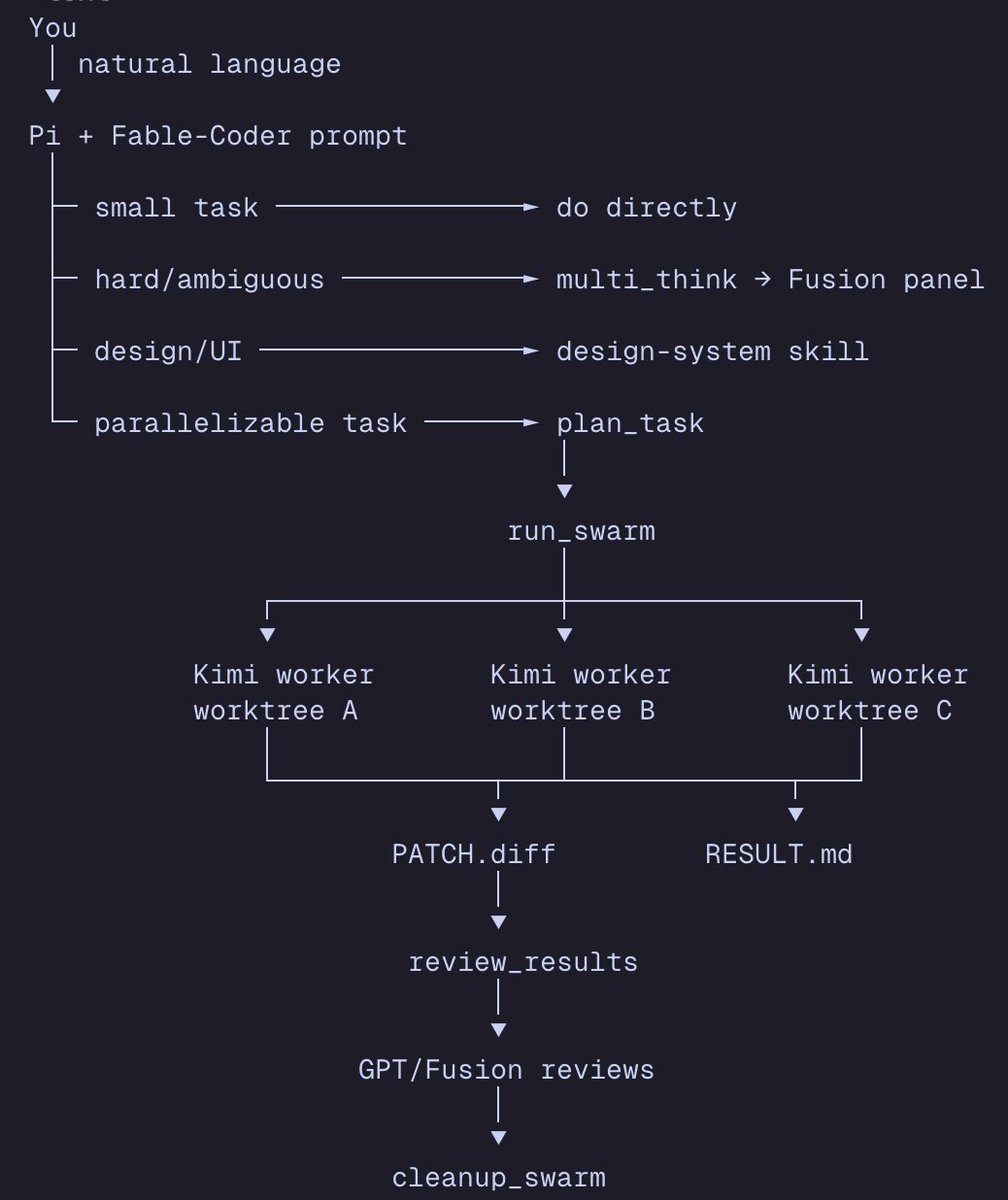
Prompt your harness to improve efficiency, especially if engineering repos are bloated. Integrate specialized models for different tasks: use FUSION via Openrouter for planning, logic, and review, and Kimi k2.7 code for subagents and execution. This leverages each model's strengths to reduce cost and boost performance.
Step 5: Test and Deploy the Harness
Have the harness 'dog food' itself—use it to refine its own configuration—until it's optimized. Then, unleash it on a real repository for deep analysis to validate its effectiveness in a practical setting.